Sherman Coolidge (1862 - 1932): Native American
Leader and Minister and Nominee
as Wyoming Citizen of the Century, By Robert Luppi
Webmaster's Note: Friends President Robert Luppi provides a brief
biography of how a young Arapaho Indian was adopted by an officer who
was wounded in the Battle of Big Hole.
Sherman Coolidge was
born in 1862 near Goose Creek in the Wind River area of Wyoming. He
was an Arapaho Indian and son to Banasda (Big Heart) and Ba-ahnoce
(Turtle Woman). His given name was Runs-on-Top and he was later
renamed Sherman Coolidge.
Tragedy struck
Runs-on-Top early in life, as when he was age 7, his father was killed
by a war party of Bannocks intent on stealing horses. The Bannocks
and Arapahos at the time were adversaries, often at war with each
other. Runs-on-Top and his younger brother, Little
One-Who-Dies-and-Lives-Again, along with their mother, escaped from
the Bannocks’ attack by hiding under a tipi cover and brush until the
fight ended.
In the spring of 1870,
the Arapahos were attacked by a large contingent of Shoshones and
Bannocks near the present site of Lander, Wyoming. At the time,
Runs-on-Top and his brother, were taken captive, but their mother was
able to escape. Eventually, the boys were given to American troops
and adopted by separate white families. Runs-on-Top was adopted later
in 1870 by Lt. Charles A. Coolidge, a career solider with the 7th
U.S. Infantry and he was renamed William Tecumseh Sherman in honor of
a Union General. William Sherman then became Sherman Coolidge. Frank
P. Rogan, the son of First Sergeant Patrick Rogan, who served with Lt.
Coolidge in the 7th Infantry, has said that his father was
instrumental in the pairing of young Sherman with his new foster
father and mother, the young officer and his wife, Sophie, who were
childless at the time.
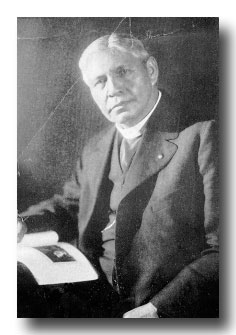
Sherman Coolidge
Under the guidance and
tutelage of his new parents, Sherman Coolidge rapidly assimilated into
the new world in which he was placed, which included an emphasis on
education and the assumption of white ways, habits, and manners. At
the age of nine, Sherman Coolidge was baptized by an Episcopal bishop
and was enrolled at the Shattuck Military School in Faribault,
Minnesota where, as an exemplary student, he consistently ranked in
the upper quarter of his class.
As Sherman grew, his
foster parents continued to encourage him to perform to the best of
his abilities and to continue on with his education. In 1876, while
accompanying his adoptive father in the latter’s journey with the
Montana Column in the campaign against the Sioux, Coolidge began to
consider becoming a missionary among the western tribes. This goal
was furthered when his parents later enrolled him in the Seabury
Divinity School near Chicago, where in 1884, he graduated with a
Bachelor of Divinity degree. That same year, he was ordained as a
Deacon in the Episcopal Church. Soon thereafter, Sherman Coolidge
traveled to the Wind River Reservation in Wyoming to engage in his
first church assignment. At Wind River, Sherman was reunited with his
birth mother, Ba-ahnoce, who had learned of his impending return.
Eventually he persuaded her to convert to Christianity. During his
early years at the reservation, Coolidge also served as a mediator
between the tribal factions of the Arapahos and Shoshones who shared
the reservation.
In 1887, Coolidge left
the reservation to enroll at Hobart College in Geneva, New York to
continue his theological studies, and after he completed his courses
in 1889, he was ordained into the priesthood. He then returned to
the Wind River Agency and ministered to the needs of Indians and
whites alike and also served the outlining communities. While
undertaking his church work, he met Grace Wetherbee, the daughter of
an affluent New York City couple. While sharing an interest and
efforts in the ministry, the couple grew to know each other and this
would eventually culminate in their marriage in October, 1902. The
bond was reached notwithstanding the advice of others disapproving of
the mixed-race marriage.
Sherman and Grace
worked together as they ministered to the needs of the Wind River
community. Sherman worked diligently on behalf of American Indians
and in 1911, he became one of the founding members of the Society of
American Indians. The Society was the first prominent
Indian-controlled rights organization in the country and Sherman
remained an influential figure in the group for a number of years.
Grace Coolidge wrote extensively about her experiences working amongst
the Indians and many of her works were published in Collier’s
Weekly and the Outlook. A collection of her works led to
the publication of “Teepee Neighbors” in 1917, which comprised a
series of touching brief stories of life on the Wind River Reservation
in the early 20th Century.
The Coolidge's raised
two daughters and adopted a number of Indian children. In the 1920s,
Sherman transferred to Colorado Springs, Colorado and he and Grace
served in churches in that state. Sherman died on January 24, 1932
and Grace died five years later, in 1937. At the closing of our last
century, Sherman Coolidge was nominated as a candidate for Wyoming
Citizen of the Century, among others who distinguished themselves in
their life by their character, contributions, and accomplishments as
Wyoming citizens during the 20th Century.
As further mention
should be made of Sherman’s adoptive father, Lt. Charles A. Coolidge,
he continued to serve in the military for 33 years after his and his
wife’s adoption of Sherman. Lt. Coolidge fought and was wounded at
the Battle of the Big Hole against the Nez Perce on August 9, 1877 and
eventually rose to the rank of Brigadier General in 1903, at which
time he retired after 40 years service with the U.S. Infantry. General
Coolidge died on January 1, 1926 at Detroit, Michigan at age 81. He
was interred at Arlington National Cemetery. His wife, Sophie, died
on January 26, 1934 at Washington, D.C.
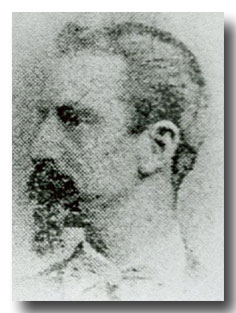
Lt. Charles A.
Coolidge
Sources: Story
by Professor George L. Cornell of Michigan State University, found in
Encyclopedia of North American Indians; Story of Sherman Coolidge
found at the American Heritage Center, University of Wyoming, Laramie,
Wyoming; Cullen, Thomas P., Rock Springs: A Look Back, Portland,
Oregon, 1991; Military records of General Coolidge; Estate records of
Sophie Coolidge.
2008 Copyright Robert Luppi
(Back
to Top)